From the NFL to philosophy: Mike DeVito tackles life’s toughest questions at UMaine
8/21/2026 2:57:00 PM | Football
A nine-year playing career, two concussions and a decade of graduate study shaped a second act centered on teaching, mentorship and meaning
ORONO, Maine -- Mike DeVito waited until the second-down play was over, dropped to the turf at Lucas Oil Stadium and grabbed his leg.
He was not injured.
The Indianapolis Colts, led by Peyton Manning, were moving quickly toward the line of scrimmage, attempting to prevent the New York Jets from substituting defensive players. Jets head coach Rex Ryan needed a way to stop the clock and get the right personnel onto the field.
His solution was DeVito.
Ryan named the play "lobster," a nod to the defensive lineman's college career at the University of Maine. DeVito's assignment was simple: Take a dive.
"At first, I was so excited to have a play named after me," DeVito said. "But then I found out that I was the guy they could most afford to have off the field for the next play."
DeVito stayed down and clutched his calf as Indianapolis offensive linemen stood over him. They knew what he was doing. The Jets' medical staff ran onto the field anyway, obligated to treat the injury as real.
DeVito only had to run "lobster" once.
The Jets went on to hand the previously undefeated Colts their first loss of the season, 29-15, on Dec. 27, 2009. DeVito continued his NFL career without giving the moment much philosophical consideration.
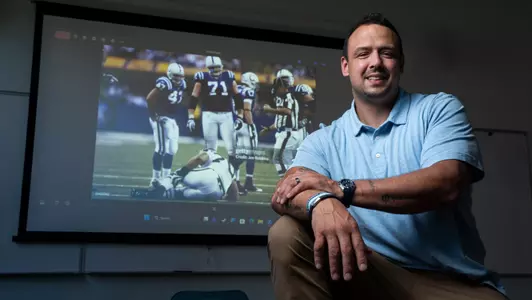
Sixteen years later, he projects a photograph of the play onto a screen inside a University of Maine classroom.
Then he asks his students: Was it ethical?
Today, DeVito is a lecturer in philosophy at UMaine and the director of player development and alumni relations for the Black Bear football program. He teaches introductory philosophy, critical thinking and applied ethics.
The former NFL defensive end has found that the story is an effective way to ease students into questions of honesty, responsibility and right and wrong.
It is applied ethics, with shoulder pads.
The path from an NFL defensive line to a philosophy classroom took nearly a decade of graduate study. It began with a book handed to DeVito in a locker room and gained urgency after two concussions helped bring his playing career to an end.
"I knew when I got done with football that I wanted to pivot to the academic space," DeVito said. "I knew I wanted to study philosophy."
In the classroom, "lobster" gives students an accessible entry point into difficult moral questions.
"It's a nice way to start because applied ethics gets into some real landmine issues," DeVito said. "This is a fun way to enter. You put your toes in a little bit."
From a distance, DeVito can identify the problems with what he did. If players routinely pretend to be injured, medical personnel may have difficulty knowing when someone is truly hurt, undermining the trust necessary to protect athletes in a violent sport.
His football brain still offers a different answer.
"Everybody's job is on the line," DeVito said. "If we don't win, we don't get paid. We go home. The morality goes out the window when you're actually out there."
He spent nine seasons colliding with offensive linemen and running backs for the Jets and Kansas City Chiefs. Now he asks students to examine free will, logic, metaphysics and the existence of God.
'Whatever this guy is doing, I want to do this'
Born in Brooklyn, DeVito moved to Cape Cod, Massachusetts, where he graduated from Nauset Regional High School. He attended UMaine from 2002-06 and played under longtime head coach Jack Cosgrove. An accounting major, he approached academics differently than he does now.
"Football was my Ph.D. then," DeVito said. "I was going to put a Ph.D. into football. That's why I was here."
After going undrafted in 2007, he signed with the team he had grown up following, the New York Jets. He played six seasons in New York and another three in Kansas City.
His academic turn began during his third NFL season, when Jets chaplain Adam Burt gave him "The Reason for God," a book by theologian and philosopher Timothy Keller.
DeVito was captivated by its arguments.
"I remember thinking, whatever this guy's doing here, I want to do this," he said.
He began reading philosophy in his free time, exploring questions of logic, knowledge, free will and metaphysics. The interest remained informal until the 2015 NFL season.
While playing for Kansas City, DeVito tackled Minnesota Vikings running back Adrian Peterson. Another defender arrived from the side, and the helmets of the two Kansas City players collided at just the wrong angle.
DeVito lost consciousness.
"They had to wake me up on the field," he said.
The concussion kept him out for three weeks. He returned, then suffered another concussion two weeks later during a game against the Oakland Raiders.
The second hit came on the final play of the third quarter. DeVito was dazed but initially believed he could continue. When play resumed, he realized something was wrong.
"Everything was just sort of all over the place," he said. "I couldn't hone in on anything."
Each game he missed cost him a $50,000 active roster bonus, but the league's concussion testing left little room for bluffing.
"I was doing everything — 'I'm fine. I'm good,'" DeVito said. "They had it down where you couldn't fake it."
The following offseason, a Kansas City coach called DeVito at home in Maine and offered him another contract.
DeVito delivered the news to his wife, Jessie. She was pregnant with their second child. Their oldest son was approaching 3.
She told him that if he returned to Kansas City, he would go alone.
The concussions had taken a toll on her, too. She did not want to watch her husband get knocked unconscious on television again. She wanted to have their baby in Maine, near their support network.
DeVito called his agent that night and retired.
"It was a hard decision," he said. "But I got to go out on my own terms."
Before leaving football, DeVito spoke with Chiefs head athletic trainer Rick Burkholder about protecting his brain from the potential long-term effects of repeated head trauma.
Burkholder advised him to exercise his brain as intensely as he had trained his body.
DeVito already knew what he wanted to study.
"I was like, 'OK, then what I'll do is go back and do philosophy in school,'" he said. "I'll actually make a formal study of it."
Starting again on academic probation
DeVito's undergraduate record did not make him an obvious candidate for doctoral study.
He entered a master's program in Christian philosophy at Houston Baptist University, now Houston Christian University, on academic probation.
He completed the program in 2018, proving he belonged in an academic setting, then earned a research-based master's degree from the University of Edinburgh before applying to doctoral programs.
He was accepted at the University of Birmingham in the United Kingdom and began his Ph.D. in fall 2020.
He completed the degree in December 2025.
His dissertation examined the longstanding philosophical problem of divine foreknowledge and human freedom.
Suppose, DeVito tells students, that an infallible being already knows what they will choose for lunch tomorrow. When lunchtime arrives, are they genuinely free to choose a burger, Thai food or nothing at all?
If that being cannot be wrong, it appears that only one outcome is possible. Yet simply knowing that something will happen does not seem to cause it.
"I know right now that you're drinking that can, but that doesn't force you to do it," DeVito said during an interview, gesturing across the table. "So why would it be that this being knowing the future would force you to do that?"
The question touches free will, time, logic, metaphysics and theology.
Defending the dissertation was intimidating.
DeVito compared it to a black belt test. He spent six months anticipating every objection his examiners might raise. Unlike a mathematical answer that can be checked, he said, a philosophical argument remains open to interpretation — and to an examiner who may challenge its premises, implications or entire approach.
"You have no idea what's coming," DeVito said.
He passed.
Back where it started
DeVito had not planned to work for the UMaine football program.
He and his family settled in Hampden, Maine, after his NFL retirement. He attended games, spoke with players and remained connected to the program as an alumnus.
Then Jordan Stevens became head coach.
Stevens and DeVito had played together on the UMaine defensive line. Stevens was a talented freshman when DeVito was a senior, and the two shared the field during DeVito's final season.
When Stevens took over the program, DeVito offered to help.
"I'm down the street," he told him. "Let me serve you, serve the team, however I can bring value."
They identified an area UMaine football did not yet have: a player development department dedicated to the parts of college life that exist beyond practices, games and grades.
DeVito's work focuses on five areas: leadership development, career development, alumni networking, social responsibility and community engagement.
He also leads a summer onboarding program for first-year players, helping them prepare for the simultaneous demands of college football and college academics.
The first group he welcomed as rookies is now entering its senior year.
"It's almost like a parent, in a sense," DeVito said. "You're just like, 'Wow, I'm so proud of these guys.'"
Because DeVito does not evaluate game film, decide playing time or monitor transcripts, players can approach him without wondering whether they are being assessed.
Sometimes player development has little to do with a formal program.
DeVito described supporting a player who was far from home and struggling with a family health crisis. It was a situation DeVito understood from his own first years at UMaine, when he often felt homesick.
They talked on the phone and met for lunch.
DeVito did not have a solution for the player's circumstances. He could listen, share his own experiences and offer a place where the student did not need to perform.
"They can just come to me and vent and talk," he said. "We're just going to work through this stuff together."
DeVito also brings philosophy and cognitive science into his work with players.
He teaches them about "amygdala hijack," a term used to describe how the brain's threat response can overwhelm rational thought. Harsh criticism from a coach can trigger an immediate impulse to fight back, make excuses or stop listening.
DeVito tells players that the response is natural. That does not make it useful.
"Recognize that your initial response is going to be, 'No, you're wrong, and here's why,'" he said. "The best thing you can do is just listen."
The same lesson appears in his critical thinking and introductory philosophy courses. A conflicting political, religious or moral claim can feel like a personal threat, making it harder to evaluate the argument rationally.
In both the classroom and the locker room, DeVito asks people to create space between the first emotional response and the next decision.
Win at breakfast
Not every lesson DeVito brings into his work originated from a philosophy book.
During his final NFL season, the Chiefs began with one victory and five losses. No team had previously recovered from that record to reach the playoffs.
After the fifth loss, head coach Andy Reid addressed the team.
He told the players to stop thinking about their record, the playoffs or even Sunday's game. Their next task was breakfast.
Win at breakfast, Reid told them. Then win in the weight room. Win in the training room. Continue through every item on the schedule.
The Chiefs won their next 10 regular-season games and a wild-card playoff game before losing in the divisional round.
DeVito shared that message with UMaine players last fall after the Black Bears began a season 0-4.
They responded with six straight wins.
Large problems invite people to catastrophize, DeVito said. Narrowing the focus to the next meal, meeting, practice or assignment makes forward movement possible.
DeVito still tries to apply Reid's advice to his own crowded life.
In addition to his football position and philosophy courses, he homeschools his three sons. The family has three educational nonnegotiables: Each child must study a foreign language, learn an instrument and practice mixed martial arts.
DeVito decided he should not ask his sons to do anything he was unwilling to try himself.
He studies German, practices the drums and continues training in mixed martial arts. His sons are learning Japanese because they love anime, giving them a level of immersion that Italian lessons did not provide.
They read books from right to left and back to front, a format DeVito said he still struggles to follow.
His two older sons play piano, while his youngest plans to learn the drums alongside his father.
DeVito said the differences between his children have also given him a new appreciation for teachers. The programs that work for one son may not work for another.
"I don't know how public school teachers do it," he said. "You have 30 students, all different types of learning styles, and it's just you."
Finishing the Ph.D. freed about four hours in DeVito's day. He quickly filled them.
There are moments when the former defensive lineman has to remind himself how improbable the combination once would have seemed: teaching the subject he loves at his alma mater, mentoring the next generation of Black Bear players and raising his family a few miles away.
"Life is great," DeVito said. "I have to kick myself sometimes."
In a University of Maine philosophy classroom, DeVito projects a photograph from Indianapolis: a defensive lineman lying on the turf, gripping a perfectly healthy leg while frustrated Colts players stare down at him.
The play was called "lobster."
The ethical questions have lasted much longer than the injury.